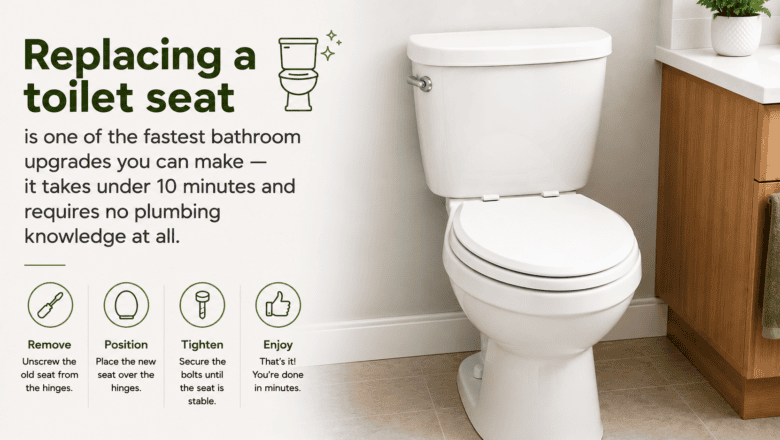
Replacing a toilet seat is the simplest bathroom upgrade imaginable — it takes 10 minutes, costs $15-50, and requires only a wrench. Whether your current seat is cracked, stained, loose, or you want to upgrade to a soft-close model that never slams, the process is the same universal bolt pattern that fits virtually every standard toilet. Understanding how to replace a toilet seat means knowing how to remove the old mounting bolts (which are sometimes corroded) and choosing the right seat shape for your toilet.
STEP 1: Determine Your Toilet Shape: Round or Elongated
Before buying a new seat, identify your toilet bowl shape. Round bowls are roughly circular and about 16.5 inches from the front of the bowl to the mounting bolt holes. Elongated bowls are oval and about 18.5 inches from front to bolts. A round seat will not cover an elongated bowl and vice versa. Measure before you shop.
STEP 2: Remove the Old Toilet Seat
With the groundwork laid, locate the two mounting bolts at the back of the seat — they are covered by plastic caps that flip or pop open. Unscrew the nuts from below the bowl while holding the bolt head on top. If the bolts are corroded metal and will not turn, spray with penetrating oil (WD-40) and wait 10 minutes. If they still will not budge, use a hacksaw to cut through the bolts from below.
STEP 3: Clean the Mounting Area Thoroughly
With the old seat removed, clean the bolt hole area and the top of the bowl rim where the seat’s rubber bumpers sit. Years of accumulation make this area surprisingly dirty. A bathroom cleaner and an old toothbrush clean the recessed areas effectively.
STEP 4: Install the New Seat
To strengthen your results even more, align the new seat’s mounting bolts with the holes in the bowl. Insert the bolts from above and thread the nuts from below, hand-tight. Adjust the seat position so it is centered on the bowl. Tighten the nuts snugly — firm enough that the seat does not shift during use but not so tight that you crack the porcelain bowl.
STEP 5: Test Stability and Adjust
To wrap up and ensure lasting results, sit on the seat and shift slightly to check for any movement. If the seat slides, tighten the bolts a quarter turn. Close and open the lid several times to test soft-close function if applicable. Snap the bolt caps closed over the mounting hardware for a clean, finished look.
PRO TIPS
Q: What is the difference between a round and elongated toilet seat?
A: Round seats measure approximately 16.5 inches from the front of the bowl to the center of the mounting bolt holes. Elongated seats measure approximately 18.5 inches. Using the wrong shape leaves the seat either hanging over the front of the bowl or not covering the bowl fully. Measure your toilet before purchasing — the shape is usually visible but measuring confirms it.
Q: Are soft-close toilet seats worth the extra cost?
A: Soft-close seats cost $5-15 more than standard seats and eliminate the loud slam that wakes sleeping family members, scares pets, and chips porcelain over time. If you have children who drop the lid, a soft-close seat is especially worthwhile. Once you experience soft-close, standard seats feel aggressively loud by comparison.
Q: How do I remove toilet seat bolts that are completely rusted and will not budge?
A: Spray penetrating oil (WD-40 or PB Blaster) on the bolts and nuts, wait 10-15 minutes, and try again. If they still will not turn, use a hacksaw or oscillating multi-tool with a metal-cutting blade to cut through the bolts from below. Replacement bolt sets cost $3-5 at any hardware store. Corroded bolts are the only challenging part of an otherwise simple job.
SUPPLIES NEEDED
New toilet seat (round or elongated to match your toilet)
Adjustable wrench or pliers
Screwdriver (flathead)
Penetrating oil (WD-40) for corroded bolts
Bathroom cleaner and old toothbrush
Hacksaw (only if bolts are severely corroded)
Products from Amazon

This site contains affiliate links. As an Amazon Associate I earn from qualifying purchases.